
Picture this: you’re on a Monday with a full screen of DeFi tabs, a limit order waiting on an L2, and a liquidity rebalancing that needs signing across two chains. You click “confirm” in your wallet and — because the signature dialog is opaque — you only discover later that a token approval granted unlimited access to your vault. That mistake is common enough that many experienced traders build manual checks into their workflow. Rabby addresses the root problem: it forces visibility into what a transaction will actually do before you sign it.
This article is a practical, mechanism‑first comparison for experienced DeFi users in the U.S. who need a secure multi‑chain wallet that reduces blind‑signing risk. I’ll unpack how Rabby’s simulation and risk scanning work, compare Rabby to mainstream alternatives, point out where it still falls short, and offer a short decision framework you can reuse when choosing a wallet for active DeFi operations.
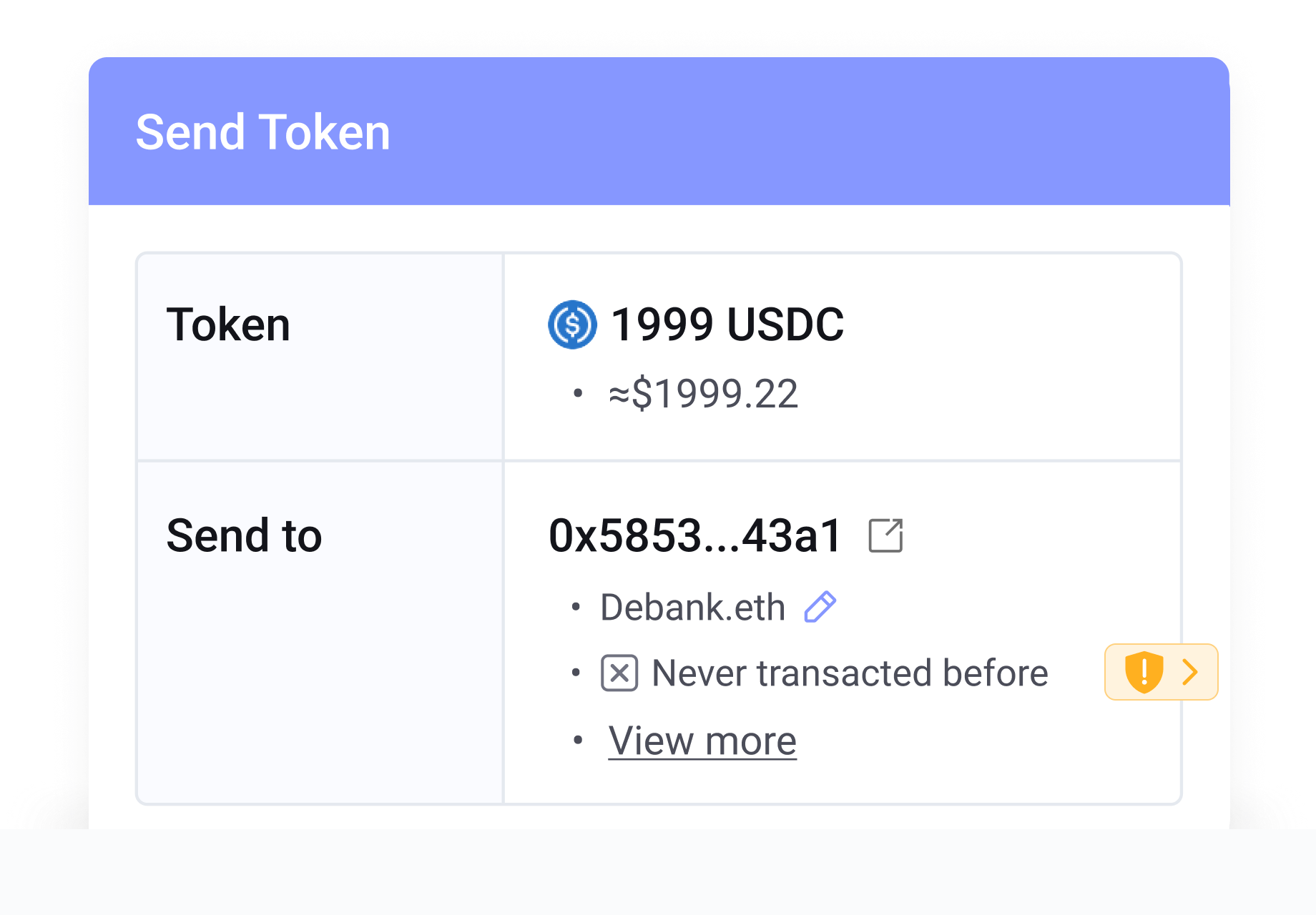
How Rabby reduces blind signing: transaction simulation and risk scanning
At the mechanism level, Rabby inserts a simulation step between the dApp call and your signature. Instead of just showing raw calldata and a gas estimate, the wallet executes a dry‑run of the proposed transaction (off‑chain or locally) to calculate estimated token balance deltas and fee costs. The UI displays those estimated inflows and outflows in plain numbers before you sign. That is different from a simple gas estimate: you’re seeing what tokens move and roughly how much you’ll end up with.
Complementing simulation is Rabby’s pre‑transaction risk engine. Before signing it checks for red flags: known exploited contract addresses, suspicious approval sizes (for example, unlimited approvals), non‑existent or newly created recipient addresses, or calls to contracts with sketchy histories. It also surfaces contextual guidance rather than burying details in a raw hex blob.
Why that combination matters: simulations catch logic‑level surprises (you didn’t realize a swap will route through a low‑liquidity pair). Risk scanning flags provenance issues and policy‑style risks (this contract has been associated with hacks). Together they change the signing decision from an opaque guess into a calibrated risk assessment.
Multi‑chain, hardware, and institutional integration: practical coverage
Rabby is explicitly built for multi‑chain DeFi workflows. It supports 90+ EVM‑compatible networks — Ethereum mainnet, Optimism, Arbitrum, Polygon, BNB Chain, Avalanche and others — and automatically switches to the correct network when you visit a dApp. For high‑frequency operators, the automatic network switching removes a common operational hazard: signing a transaction on the wrong chain because your wallet was still on Mainnet.
Hardware compatibility is broad: Ledger, Trezor, Keystone, CoolWallet, GridPlus, and BitBox02 are supported. For institutional setups, Rabby integrates with multi‑sig and custody solutions like Gnosis Safe and Fireblocks. Those integrations make Rabby usable both for a solo trader using a hardware device and for a small fund running a multi‑sig policy.
Another practical feature: built‑in approval revocation and a cross‑chain gas top‑up tool. The former helps reduce exposure from past approvals; the latter addresses a routine pain point when you need to operate on a chain without native gas. Combined with portfolio aggregation across chains (tokens, NFTs, liquidity positions), Rabby functions as both a transactional interface and a monitoring console.
Where Rabby wins versus common alternatives — and where it doesn’t
Compared to MetaMask, Trust Wallet, or Coinbase Wallet, Rabby’s primary differentiator is the mandatory simulation and the risk scanning. MetaMask shows calldata and gas; it leaves the cognitive work to you. Rabby makes that work explicit and quantifiable. For power users doing complex interactions — multi‑hop trades, DeFi composability actions, approvals for aggregators — that can materially lower the chance of costly mistakes.
But Rabby is not a perfect one‑size‑fits‑all solution. Two practical limitations matter for U.S. DeFi users. First, Rabby does not have an in‑wallet fiat on‑ramp; if you need to buy crypto with USD, you’ll still rely on exchanges or third‑party services. Second, it doesn’t provide native in‑wallet staking flows. If your routine is buy → stake in one seamless flow, Rabby requires an extra step or an external staking UI.
Security history also deserves honest treatment. In 2022, a Rabby Swap smart contract was exploited for approximately $190,000. The team froze the contract, compensated users, and increased audits. That incident illustrates two truths: every codebase and contract surface can be attacked, and how a project responds (freeze, compensate, audit) is a real part of the security risk model. Rabby’s open‑source MIT codebase and third‑party audits increase transparency, but openness is not the same as immunity.
Decision framework: which users should pick Rabby, which should not
Here’s a simple heuristic for power users:
– Choose Rabby if you: frequently interact with complex dApps across multiple EVM chains, use hardware wallets or multi‑sig for custody, or want pre‑transaction transparency to reduce blind‑signing risk. The simulation + revocation combo is especially valuable for traders and builders juggling many approvals and chained operations.
– Consider alternatives if you: need integrated fiat purchases inside the wallet, want one‑click staking flows, or prefer a dramatically simpler mobile‑first interface. For casual custodial users who prioritize a single exchange integration and ease over fine‑grained signing control, Rabby’s added prompts may feel like friction.
Operational trade‑offs to weigh: simulations add latency and complexity to the signing flow. If you are running arbitrage where every millisecond matters, that latency could be a disadvantage. Conversely, for most non‑latency‑sensitive DeFi activity, the marginal time cost buys meaningful reduction in smart contract risk.
Practical setup and safety checklist for U.S. power users
Install Rabby only from official sources, and pair it to a hardware device for high‑value balances. Use the Flip toggle if you want to run Rabby alongside MetaMask during a migration. For every approval, favor limited allowances rather than unlimited approvals; use Rabby’s revocation screen to tidy old approvals monthly. Finally, keep a small gas reserve on each chain you commonly use or rely on Rabby’s cross‑chain gas top‑up when you need to act fast.
If you want to explore downloads and installation options (desktop, extension, or mobile), start with the project’s official download page for clear links to each platform: rabby wallet.
What to watch next (signals that would change the recommendation)
Monitor a few concrete signals: additional third‑party audits and published bug‑bounty findings would strengthen Rabby’s security posture; native fiat on‑ramp partnerships or staking integrations would expand its suitability for mainstream flows; and any recurrence of exploit classes similar to 2022 would raise caution flags. Each of those outcomes alters the cost‑benefit calculus for institutions and high‑net‑worth users.
Finally, watch how competing wallets adopt simulation features. If simulation becomes standard across the ecosystem, Rabby’s lead would narrow and decision factors would shift toward UX, custody integrations, and regulatory posture.
FAQ
Does Rabby prevent all scams and hacks?
No. Rabby’s simulation and risk scanning reduce certain classes of risk — especially blind signing and careless approvals — but they cannot prevent smart contract bugs in third‑party protocols or novel exploit techniques. Simulations are estimates and can miss chain‑level front‑running or MEV‑related outcomes. Use hardware keys, limit approvals, and diversify custody for high value holdings.
Can I keep using MetaMask and Rabby together?
Yes. Rabby provides a Flip toggle to switch default behavior between it and MetaMask. Running both can be useful during migration: keep your active MetaMask account for some apps and let Rabby handle transactions where simulation and risk scans matter most. Always double‑check which wallet is connected before confirming a signature.
Is Rabby suitable for institutional custody?
Rabby integrates with multi‑sig and enterprise custody tools such as Gnosis Safe and Fireblocks, which makes it compatible with institutional workflows. Still, institutions should evaluate operational policies, audit trails, and legal/regulatory compliance of any wallet + custody stack before adoption.